
- By admin
- 2026 September 11.
- Active Ingredients, azelaic acid
Az azelainsav (azelaic acid) has become one of the most interesting skincare active ingredients in recent years – although it is by no means a new discovery. Dermatology has long used it, among other things, in the treatment of acne and rosacea, and in modern Korean cosmetics, it is increasingly found in formulations that can be easily incorporated into everyday routines.
Its speciality is that it can be useful in caring for several, often co-occurring skin problems at once: problematic, acne-prone skin, post-acne marks, uneven skin tone, and redness are all conditions where this active ingredient is of interest.
But how does it work? How is it different from AHA or BHA acids? What can it be combined with, and which Korean azelaic acid serum is worth choosing? In this guide, we will go through it all.
🌿 What is azelaic acid?
Azelaic acid – in English azelaic acid – is a dicarboxylic acid. Despite the term “acid,” it does not belong to the family of AHA and BHA acids, so it should not be simply considered as another exfoliant.
Its mechanism of action is complex: its antimicrobial and anti-inflammatory properties, its effect on keratinisation, as well as its influence on the activity of the tyrosinase enzyme involved in pigment formation have all been studied.
It is precisely this versatility that makes it special.
✨ What can azelaic acid do for your skin?
🔸 Acne and skin prone to congestion
Azelaic acid has long been used in the treatment of acne. It can affect several processes involved in the development of acne, while its anti-inflammatory properties may also be beneficial in cases of inflamed lesions.
🔸 Brown spots remaining after acne
Azelaic acid can affect the activity of the tyrosinase enzyme involved in melanin production, which is why it is also used for hyperpigmentation and darker spots remaining after acne.
🔸 Skin prone to redness and rosacea
Azelaic acid has a significant dermatological history in the treatment of rosacea. However, it is important to distinguish between cosmetic azelaic acid serums and medicinal products used for rosacea treatment. In cases of persistent or severe redness, diagnosis and treatment are the responsibility of a dermatologist.
🔸 Uneven skin tone
Since it can be relevant both for inflammatory processes and pigmentation, it can be a particularly good choice for skin where spots remain for a long time after acne.
💚 Who might it be a good choice for?
Azelaic acid may be particularly interesting if your skin is:
- prone to acne and congestion,
- easily marked after acne,
- uneven in tone,
- prone to redness,
- or you are looking for a multifunctional active ingredient that can be incorporated into a well-considered routine over the long term.
And it is not exclusively for teenage oily, acne-prone skin: it can also be a relevant active ingredient for adult acne and the pigmentation marks left afterwards.
🧪 10%, 15% or 20% – does the concentration matter?
Yes – but a higher percentage does not automatically mean a better cosmetic product.
A significant portion of clinical evidence has been established with higher concentration dermatological preparations. Among Korean cosmetics, however, many 10% formulas can be found, often combined with soothing, hydrating, or sebum balance-supporting ingredients.
The finished formula, the carrier substance, the form of azelaic acid, and the complete INCI all matter. Therefore, do not just look at the percentage on the label.
🌱 Which Korean azelaic acid serum should you choose?
Azelaic acid products are not all the same. Some focus more on redness and hydration, others on acne and spots, and yet others approach more intensive skin texture care. The selection below helps you navigate.
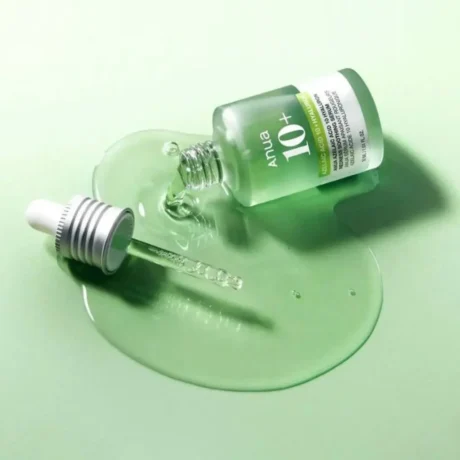
ANUA Azelaic Acid 10 Hyaluron Redness Soothing Serum
ANUA 10% azelaic acid combined with hyaluronic acid and several soothing ingredients.
Who would we look at first?
For acne, spots, and redness-prone, dehydrated skin alike.
The formula is primarily interesting if, alongside problematic skin, redness and dehydration are also important considerations. Therefore, it is worth taking into account not only the concentration of azelaic acid but also the overall soothing and hydrating direction of the formula.
NINELESS A-Control 10% Azelaic Acid Serum
NINELESS A-Control approaches more from the perspective of oily, clogged, and acne-prone skin.
Who should we examine first?
For oilier, problematic skin, especially if spots remain after acne.
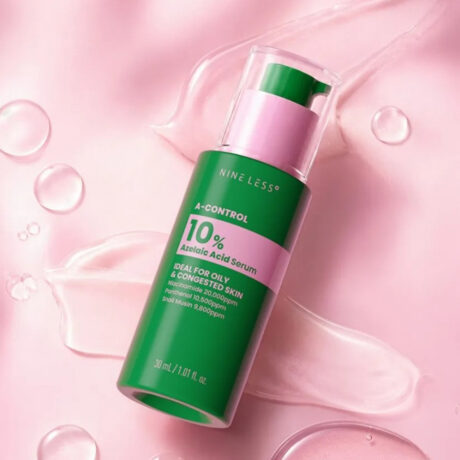
The formula containing 10% azelaic acid, along with niacinamide, panthenol, and snail mucin, is a good example of how the same main active ingredient can be formulated for very different skin needs.
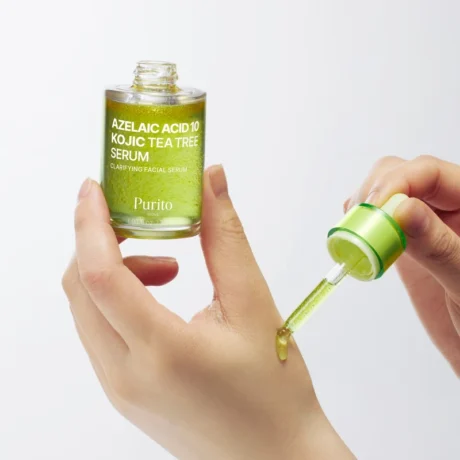
PURITO SEOUL Azelaic Acid 10 Kojic Tea Tree Serum
Targeted combination: 10% azelaic acid + kojic acid + tea tree.
Who would we look at first?
For problematic skin prone to scarring after acne, where spot fading is a primary goal.
The PURITO SEOUL formula is therefore primarily of interest to those who, in addition to acne, also have spots and uneven skin tone as a prominent issue. If this is your main goal, please also read our detailed guide on kojic acid.
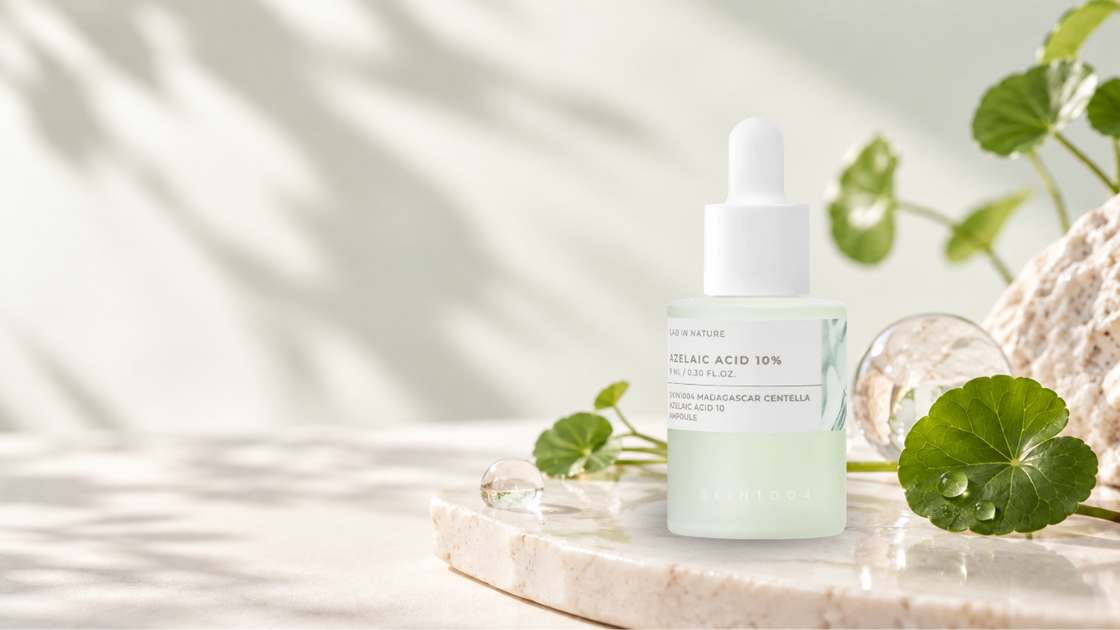
SKIN1004 Madagascar Centella Azelaic Acid 10 Ampoule
SKIN1004 associates azelaic acid with the brand-characteristic Centella asiatica line.
Who would we look at first?
For skin that feels more sensitive, problematic, and prone to redness.
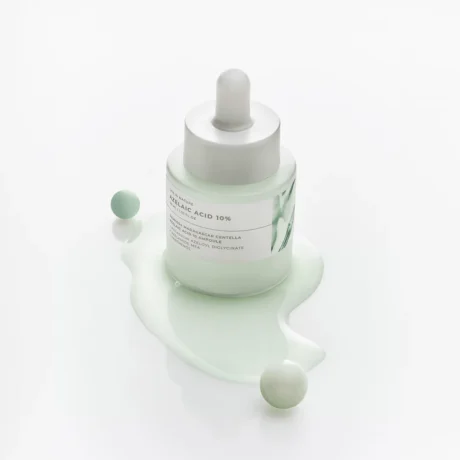
This of the four 10% formulas most represents the direction of “problematic skin that also desires soothing”: alongside the active ingredient, components supporting skin comfort are included.
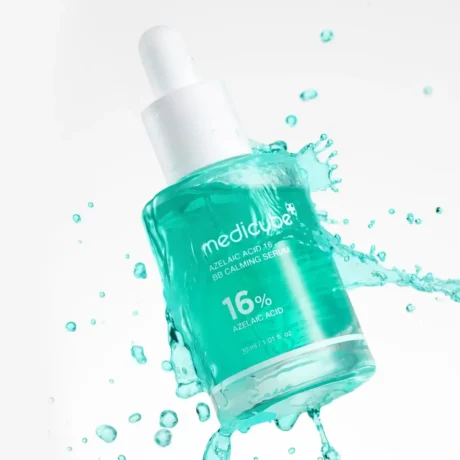
medicube Azelaic Acid 16 BB Soothing Serum
The Medicube serum is an azelaic acid-based formula focused on problematic skin.
Who should we look at first?
For uneven textured, problematic, combination or oilier skin.
When selecting the product, it is not advisable to focus solely on the number indicated on the packaging: the entire formula and the form of azelaic acid used together determine the place it should have in the routine.
🧬 And what about the medicube Azelaic Acid Exosome Shot ampoules?
The medicube Azelaic Acid Exosome Shot 2000 and 7500 represent different categories: ampoules containing micro-particle (spicule) technology, niacinamide, azelaic acid, and exosome ingredients.
The 2000 is the gentler entry-level version, while the 7500 is more intensive and suited for those already familiar with this technology. A tingling sensation may occur during use, so these should not be treated the same way as a classic 10% azelaic acid serum.
→ Azelaic Acid Exosome Shot 2000
→ Azelaic Acid Exosome Shot 7500
🪜 How to incorporate azelaic acid into your routine?
If you have never used azelaic acid before, you do not need to start using it twice daily immediately. It is advisable to begin with less frequent use, then gradually increase the frequency depending on your skin’s reaction and the specific product’s instructions for use.
A simple evening routine:
🫧 cleansing → 💧 toner/essence (optional) → 🌿 azelaic acid serum → 🧴 moisturizer
A mild tingling or drier sensation may occur at the beginning of use. However, if you experience strong burning, persistent irritation, or significant redness, discontinue use.
🧩 What can azelaic acid be combined with?
With niacinamide: yes. A particularly obvious combination for problematic, blotchy or uneven skin tone.
With hyaluronic acid: yes. A simple hydrating companion alongside azelaic acid.
With centella and panthenol: yes. A good combination if you want to consider the skin’s comfort alongside the active ingredient.
With vitamin C: they can be combined, but with sensitive skin it is not necessary to layer them at the same time. A simple solution could be vitamin C in the morning, azelaic acid in the evening.
With retinol or retinal: they can be used in the same routine, but for beginners or sensitive skin, it may be advisable to use them on separate evenings.
With AHA/BHA acids: tolerance is also important here. Multiple potentially irritating actives in one routine can easily be too much.
An effective routine is not achieved by using all active ingredients at once.
☀️ Is sunscreen necessary alongside azelaic acid?
Sun protection is one of the most important steps in the morning routine anyway, and it is especially crucial when fading pigmentation spots. UV radiation can contribute to the persistence or worsening of hyperpigmentation.
In other words, no matter how well-structured your spot-fading routine is, it will be ineffective if your skin is regularly exposed to significant UV radiation without proper sun protection.
🤰 Is azelaic acid safe to use during pregnancy?
Azelaic acid is mentioned by several professional sources as a topical active ingredient that can be considered during pregnancy. Nevertheless, during pregnancy and breastfeeding – especially with complex cosmetics containing multiple active ingredients – it is advisable to consult a doctor about the full composition of the product.
❓ Frequently Asked Questions about azelaic acid
Is azelaic acid an exfoliating acid?
It is not a classic AHA or BHA. It can affect keratinisation, but it should not simply be treated as an alternative to glycolic acid or salicylic acid.
Azelaic acid or salicylic acid for acne?
It is not necessarily an either-or situation. Salicylic acid can be particularly interesting for oily, congestion-prone skin; the advantage of azelaic acid is that, besides problematic skin, it can also be relevant for post-acne pigmentation spots and redness.
Azelaic acid or niacinamide?
You do not necessarily have to choose between them. Several ready-made formulas use both together.
How long does it take to see results?
Do not think in terms of just a few days. Consistent use over several weeks is more important than chasing quick results.
Can it be used every day?
If your skin tolerates it well and the product’s instructions also recommend this, then yes. However, as a beginner, it is advisable to introduce it gradually.
✅ Summary – why is azelaic acid interesting?
There are few active ingredients that can be simultaneously interesting for problematic skin, redness, and pigmentation marks remaining after inflammation.
Azelaic acid has a much longer dermatological history than since it came into the spotlight in K-beauty trends. Modern Korean formulations precisely demonstrate how the same active ingredient can be associated with very different skin needs.
If you want to see all currently available azelaic acid products, browse the MyBelle azelaic acid active ingredient page.
