
- By admin
- 2026 October 10.
- Skincare Tips
Hydration or nourishment? This is how humectants, emollients, and occlusive ingredients work
Why might your skin feel tight even if you regularly moisturise it? Why can it be both oily and dehydrated at the same time? And why is it that a light hyaluronic acid serum alone is sometimes not enough, while a richer cream almost immediately makes your skin feel more comfortable?
The answer partly lies in the fact that cosmetics do not support skin hydration in the same way.
The ingredients of moisturising products are often categorised into three main groups based on their function: humectants, emollients, and occlusive ingredients. Although in everyday use they are all associated with moisturising, they actually perform different roles.
If you understand the difference, you can much more easily decide what your skin needs – and also why the most expensive or the thickest cream is not necessarily the best choice for you.
If you are not yet sure whether your skin is dry or rather dehydrated, it is worth clarifying the difference between the two first. We wrote about this in detail in our article “Dry or Dehydrated Skin? How to Recognise the Difference”.
💧 Humectants – which help to retain water
Humectants are water-binding ingredients. Their role is to help maintain the proper hydration of the skin’s outermost layer.
Humectants bind water from their environment and may also contribute to the distribution of water within the skin. Their effect is influenced by the complete composition of the product, the environmental humidity, and the condition of the skin.
A properly hydrated stratum corneum is more elastic and smoother to the touch, and the fine lines that become more pronounced due to lack of moisture may also be less noticeable.
What are the most well-known humectants?
- Hyaluronic Acid (Hyaluronic Acid, Sodium Hyaluronate): an ingredient known for its water-binding properties, available in various molecular weight forms in cosmetics.
- Glycerin (Glycerin): one of the oldest used, well-researched, and effective moisturizing ingredients.
- Panthenol: besides its water-binding property, it may also support the skin’s comfort and the function of its protective layer.
- Betaine: a moisturizing and skin-conditioning ingredient.
- Sodium PCA: a water-binding substance associated with the skin’s natural moisturizing factor (NMF).
- Urea: at lower concentrations it acts as a moisturizer, while at higher concentrations it may also help to loosen the thickened stratum corneum.
Why is a hyaluronic acid serum not always sufficient?
Because water retention and the reduction of water loss are two distinct processes.
If the skin’s protective layer is more vulnerable, moisture can escape from it more easily. In such cases, a light serum rich in moisture-binding ingredients can provide pleasant hydration, but it may happen that the feeling of comfort does not last long.
This does not mean that hyaluronic acid does not work. Rather, it means that your skin may need ingredients that soften the skin and reduce water loss, in addition to water retention.
🧴 Emollients – which soften and smooth the skin
Emollients primarily play a role in softening the skin, smoothing it, and improving the sensation of comfort.
They help reduce the roughness of the skin surface, making the skin feel softer, more elastic, and more pleasant to the touch. They can be particularly useful for dry, rough, or flaky-prone skin.
Common emollient ingredients
- Squalane: a light, well-spreading skin-softening ingredient, often derived from plant-based raw materials.
- Shea Butter (Butyrospermum Parkii Butter): a richer plant butter that softens the skin and may also play a role in reducing water loss.
- Caprylic/Capric Triglyceride: a widely used emollient that provides a pleasant skin feel.
- Jojoba Oil (Simmondsia Chinensis Seed Oil): a plant-derived ingredient rich in wax esters.
- Vegetable oils: for example sunflower, argan, or oat seed oil, which have various skincare properties depending on their composition.
It is important to note that an emollient does not necessarily imply a heavy or greasy texture. A light, quickly absorbable moisturising cream can also contain effective skin-softening ingredients.
Is shea butter emollient or occlusive?
Both are possible, but primarily we classify it as an emollient.
Shea butter softens and smooths the skin, while its oily components may also contribute to reducing water loss to some extent.
This is a good example that the three component groups cannot be sharply separated from each other. A single substance can serve multiple functions, and its actual effect is also influenced by the final formula.
🛡️ Occlusive ingredients – which help reduce water loss
The skin continuously loses some water to its environment. This is a natural physiological process called TEWL, based on the English term transepidermal water loss, meaning water loss through the skin.
If the skin’s protective layer does not function properly, water loss may increase. At such times, the skin can feel tight, become dry, rougher, and more sensitive.
Occlusive ingredients help reduce water evaporation by forming a protective layer on the skin’s surface.
What occlusive ingredients might we encounter?
- Petrolatum (Vaseline): a highly occlusive ingredient, safely usable in properly refined cosmetic quality.
- Mineral Oil (Paraffinum Liquidum): purified mineral oil with skin-softening and water loss-reducing properties.
- Dimethicone: a silicone-based ingredient with film-forming and skin-protective properties, which can also provide a pleasantly smooth skin feel.
- Beeswax (Cera Alba): a naturally derived substance with film-forming and partly occlusive properties.
- Plant waxes: for example, candelilla wax and carnauba wax, which primarily contribute to skin protection through their film-forming properties.
The effectiveness of various occlusive ingredients is not the same. For example, petrolatum is particularly known for its strong water loss reducing properties, while other substances may have milder effects.
Are petroleum-derived ingredients hazardous?
Petrolatum and mineral oil are indeed substances derived from crude oil, but it is important to distinguish between the raw material and the version suitably refined for cosmetic use.
Cosmetic-grade variants of appropriate purity are considered safe when used as intended.
The origin of the ingredient alone does not determine whether a substance is safe or effective. Among plant-based materials, there are also ingredients that can cause irritation or allergic reactions.
At the same time, it is completely understandable if someone prefers to choose products containing plant-based emollients and waxes due to personal preference.
Safety, efficiency, and personal preference are three distinct aspects.
🧱 Ceramides – important building blocks of the skin's natural protective layer
When talking about hydration, we must not omit ceramides either.
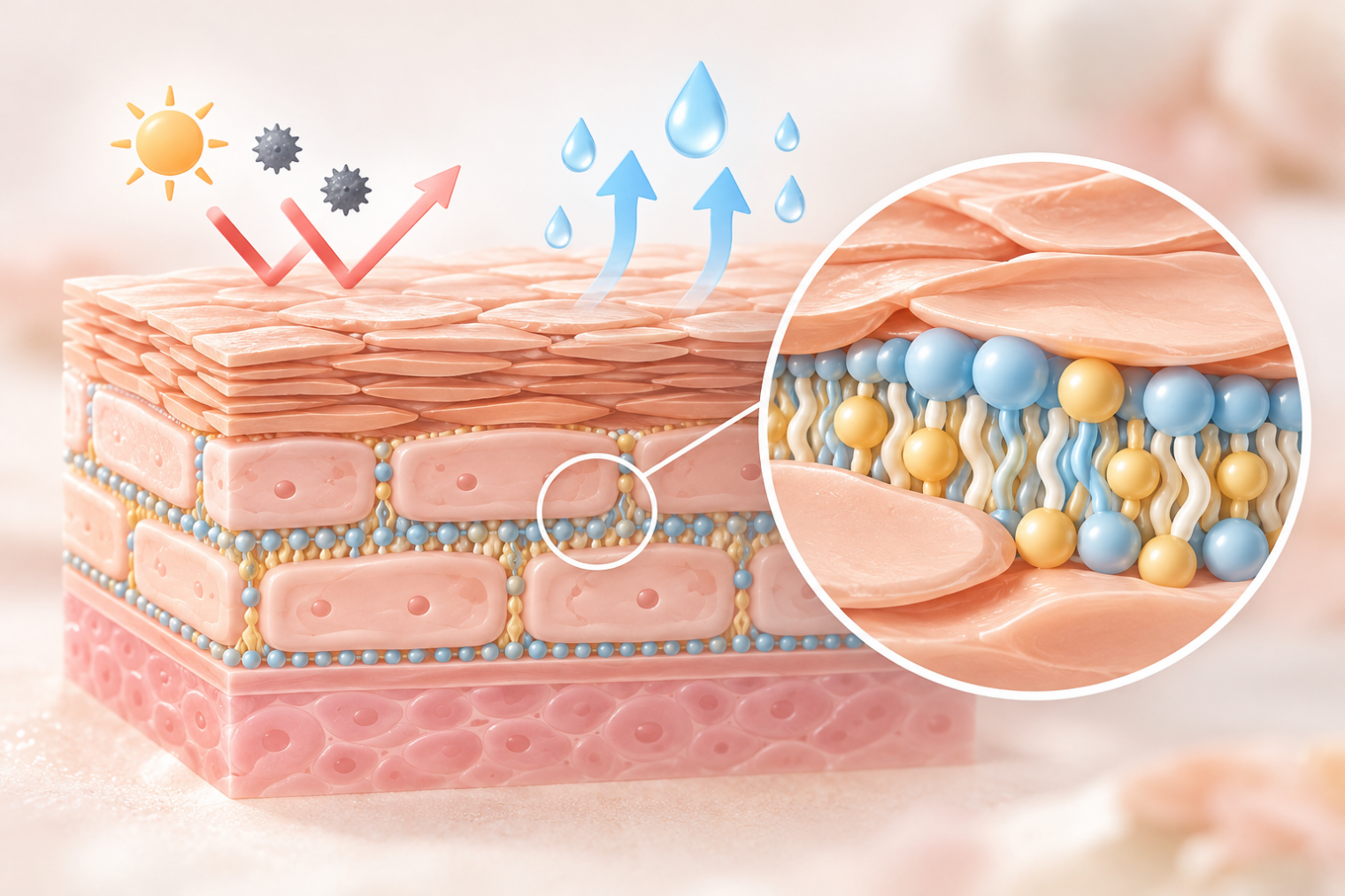
Ceramides are particularly interesting because they do not merely form a coating on the surface of the skin, but are important components of the skin’s natural lipid layer.
How does the skin's protective layer work?
Imagine a brick wall!
In the outermost layer of the skin, the stratum corneum, the corneocytes form the bricks, while the lipids located between them act as the mortar.
This lipid content is composed, among other things, of three important groups of components:
- Ceramides
- Cholesterol
- Free fatty acids
Their proper structure and proportion are important for the skin’s protective layer to function well.
The barrier helps to reduce excessive water loss while providing protection against external environmental effects.
What happens if the skin's lipid layer becomes more vulnerable?
The skin loses water more easily, and may feel drier, rougher, or more sensitive.
Cosmetics containing ceramides and other barrier lipids can help support the lipid content of the stratum corneum and the skin’s protective function.
They may be particularly interesting in cases of dry, sensitive, or skin prone to increased water loss.
Is ceramide a humectant, emollient, or occlusive?
Ceramides can be most accurately described as barrier lipids.
Although formulas containing ceramides can improve skin hydration and reduce water loss, their function is not the same as a simple, surface occlusive layer.
Ceramides are connected to the skin’s natural lipid structure, making them particularly important in barrier care.
On the INCI list, you can find the following names: Ceramide NP, Ceramide AP, Ceramide EOP.
It is important to note, however, that the presence of a single ceramide alone does not guarantee the efficacy of a product. The concentration, other lipids, composition, and the complete formula all matter.
A good example of a barrier cream containing ceramides is the Celimax Dual Barrier Skin Wearable Cream, which has been specifically developed to support the skin’s comfort and protective layer.
🌿 Why is the Korean approach to hydration in cosmetics interesting?
One distinctive approach of Korean skincare is that hydration is often supported by a combination of several complementary ingredients.
For example, in a moisturising cream, you can find at the same time:
- With glycerin and hyaluronic acid, which help to retain water.
- With squalane or shea butter, which soften and smooth the skin.
- With ceramides, which are connected to the skin’s natural lipid layer.
- With panthenol, which has moisturizing and skin comfort supporting properties.
- With film-forming ingredients, which may help reduce water loss.
This is naturally not exclusive to Korean cosmetics: modern moisturisers worldwide often combine several mechanisms.
However, in the Korean skincare range, one can encounter an especially wide variety of textures, from light gels and lotions to richer barrier creams.
Thus, for different skin types and skin conditions, one can choose from various textures of complex moisturizing formulas.
A good example is the Dr.Althea Aqua Marine product line: the light, hyaluronic acid Deep Serum and the hydrating, skin-softening ingredient-containing Watery Cream complement each other and can be incorporated into a routine designed for dehydrated skin.
Multiple ingredients – in a single cream
Good hydration does not necessarily mean that you have to layer three or four different serums on top of each other.
A well-formulated moisturising cream can on its own contain humectants, emollients, occlusive ingredients, and barrier lipids.
Together, these can support the skin’s hydration and comfort from multiple angles.
The goal is not to use as many ingredients as possible, but to choose a combination that suits your skin’s needs.
This approach is well exemplified by the ZIPIDERM EGF Skin Barrier Hydrating Cream: a hydrating cream where several complementary ingredients can aid in skin care.
✨ Humectant, emollient, occlusive or barrier lipid – what is the difference?
| Ingredient group | Primary role | Examples |
|---|---|---|
| Humectants | Water binding | Glycerin, hyaluronic acid, betaine |
| Emollients | Softening and smoothing the skin | Squalane, shea butter, vegetable oils |
| Occlusive ingredients | Reduction of water loss | Petrolatum, dimethicone, waxes |
| Barrier lipids | Supporting the skin’s natural lipid structure | Ceramides, cholesterol, fatty acids |
There may be overlap between categories. For example, shea butter has emollient and partly occlusive properties, while dimethicone can be both a skin softener and a water loss reducing ingredient.
The table therefore shows the most characteristic functions, not an exclusive classification.
💜 What kind of hydration does your skin need?
If your skin is dehydrated
Dehydration is a skin condition that can occur regardless of skin type. Your skin may be oily, combination, or dry, and still be dehydrated.
In such cases, it is advisable to look for products containing moisture-binding ingredients, such as glycerin, hyaluronic acid, or betaine.
If your skin loses moisture easily, a light emollient moisturiser with ingredients that reduce water loss can also be beneficial.
If your skin is dry
Dry skin often produces less sebum, which can lead to a rough, tight sensation. In such cases, a water-based serum alone is not always sufficient.
It is advisable to choose a moisturiser that contains humectants, emollient ingredients, and substances that reduce water loss.
Formulations composed of ceramides, squalane, glycerin, and panthenol can provide a good starting point.
If your skin is oily but dehydrated
Oily skin also needs hydration. However, the appropriate moisturizer does not necessarily have the same texture as one would choose for dry skin.
Light gels, gel creams and lotions can be more pleasant, especially if you do not like rich, greasy-feeling products.
Glycerin, hyaluronic acid and lighter emollients can also be useful in such cases.
If your skin barrier is sensitive or more vulnerable
In such cases, a simple, well-tolerated routine can be particularly important.
A fragrance-free moisturising cream that contains humectants, emollients, and barrier lipids can be a good choice.
Ceramides, glycerin, panthenol and appropriate skin-softening ingredients can help support the skin’s comfort and protective function.
If your skin often feels tight, becomes red or is easily irritated, it is also worth looking among products selected for damaged skin barriers.
In cases of persistent irritation, inflammation, or eczema symptoms, however, cosmetic care does not replace dermatological treatment.
❓ Frequently Asked Questions about Moisturising Ingredients
Is a hyaluronic acid serum sufficient for skin hydration?
In some cases, yes, but for drier skin or skin prone to increased water loss, emollient and occlusive ingredients may also be necessary.
Is glycerin better than hyaluronic acid?
Not necessarily. Both can be effective humectants. Glycerin is particularly well-researched and widely used, but the overall formulation of the product is more important than the popularity of a single active ingredient.
Do ceramides hydrate?
Ceramides are not primarily water-binding substances. They are important components of the skin’s natural lipid layer, thus contributing to the maintenance of proper hydration by supporting the barrier function.
Are naturally derived ingredients safer?
Not necessarily. Safety is determined by the properties, purity, concentration of the given substance, the final formula, and the conditions of use. Naturally derived ingredients can also cause irritation or allergies.
Is a separate hydrating serum necessary under the cream?
Not necessarily. If your moisturiser alone provides sufficient comfort, there is no need to use a separate serum. A serum can be a useful addition if you require extra hydration or targeted active ingredients.
Does the thickest cream provide the best hydration?
Not necessarily. Texture is not the same as moisturizing effectiveness. A lighter cream can be well formulated, while a richer formula may not be comfortable for every skin type.
💜 Summary – proper hydration depends on the cooperation of the ingredients
Hydration is much more than just using a single hyaluronic acid serum.
Humectants help to bind water, emollients soften and smooth the skin, occlusive ingredients reduce moisture loss, and ceramides and other barrier lipids play an important role in the function of the skin’s natural protective layer.
A well-formulated moisturising cream can combine several of these mechanisms.
Therefore, you do not necessarily need a long, multi-step routine. It is much more important to understand the needs of your skin and to choose products that complement each other appropriately.
Good skincare depends not on the number of products, but on thoughtful selection.
If you are not yet sure whether your skin is dry or dehydrated, it is worth clarifying this first. Understanding the difference between the two can help you choose the truly appropriate moisturizer.
