
- By admin
- 2026 September 12.
- Skincare Tips, Beauty
- Comments:7
When it comes to Korean skincare, many people still think of a bathroom shelf lined with ten different bottles, which must be used in strict order every morning and evening.
However, the 10-step Korean facial care routine is not a mandatory programme, and certainly not a challenge to be completed.
It is much more a system that helps to understand the role that different product types can play in skincare, how they build upon each other, and when your skin might need each one.
The 10 steps are not a rule. A map.
And to make this easier to imagine, think of a classic Italian meal sequence. Just because after the antipasto primo piatto, secondo piatto, contorno and dolce may follow, it doesn’t mean you have to eat the entire menu on an average weekday. Sometimes a good pasta is just enough – perhaps with a little dessert. 
The Korean routine is like this too. You can know all ten steps without having to use all ten every day.
In fact, if you are just starting to get acquainted with conscious skincare, it’s better not to order the entire menu right away.
🧭 What does the 10-step Korean routine really mean?
The classic routine generally follows this order:
1. oil-based cleansing → 2. water-based cleansing → 3. exfoliation → 4. toning → 5. essence → 6. serum or ampoule → 7. sheet mask → 8. eye care → 9. moisturising → 10. sun protection
At first glance, it does indeed seem like a lot. However, the list can be misleading if read as though every item is a daily task.
Exfoliation and sheet masks are occasional steps, sunscreen is part of the morning routine, and eye cream is entirely optional for many. Neither toner nor essence is necessarily required at the same time.
In skincare, more is not automatically better. Using too many products – especially multiple active formulations simultaneously – can irritate the skin.
A good routine is therefore not defined by having ten products. Much more important is gentle cleansing, proper hydration, consistent sun protection, targeted use of active ingredients, and adapting to the current condition of the skin.
🫧 1–2. Oil-based and water-based cleansing – starting with a clean base
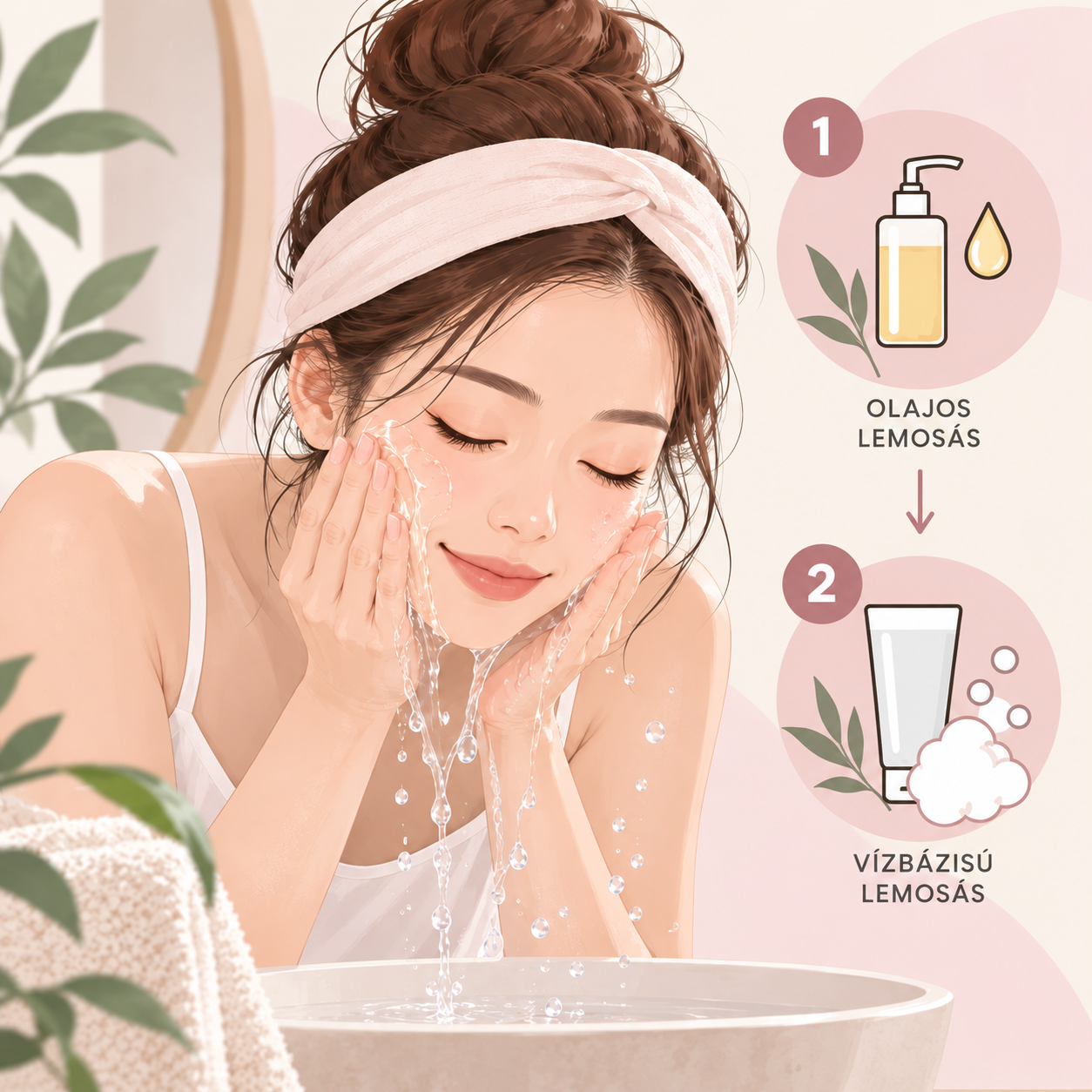
1. Oil Cleansing
Oil cleansers can be particularly useful for removing oil-soluble impurities such as makeup, sebum, and more stubborn sunscreens.
They are generally used in the evening routine. Apply to dry skin, gently massage over the face, then emulsify with a little water. The oily texture will turn milky, after which it can be thoroughly rinsed off.
But here we can immediately dismiss the first K-beauty dogma: double cleansing is not mandatory for everyone or every evening.
In a clinical study, both traditional cleanser and oil-based cleanser effectively removed the tested non-waterproof sunscreen. However, in the case of waterproof sunscreen, the oil-based cleanser left significantly fewer residues. The study was conducted with only twenty participants and specific products, so it is not advisable to create a general rule for all sunscreens based on this.
When is it particularly advisable to consider this? Makeup, waterproof or more stubborn sunscreens, or when there is a greater need for evening cleansing.
2. Water-based cleansing
The second step is a gentle water-based facial cleanser. In double cleansing, this follows the oil-based cleanser, while on its own it serves as a single cleansing step in many routines.
The goal here is not “squeaky clean”. If your skin regularly feels tight, uncomfortably dry, or stretched after washing your face, it is worth reconsidering your chosen cleanser and the frequency of cleansing.
In the morning, double cleansing is generally not necessary.
🌿 3–4. Exfoliation and toning – only as much as necessary
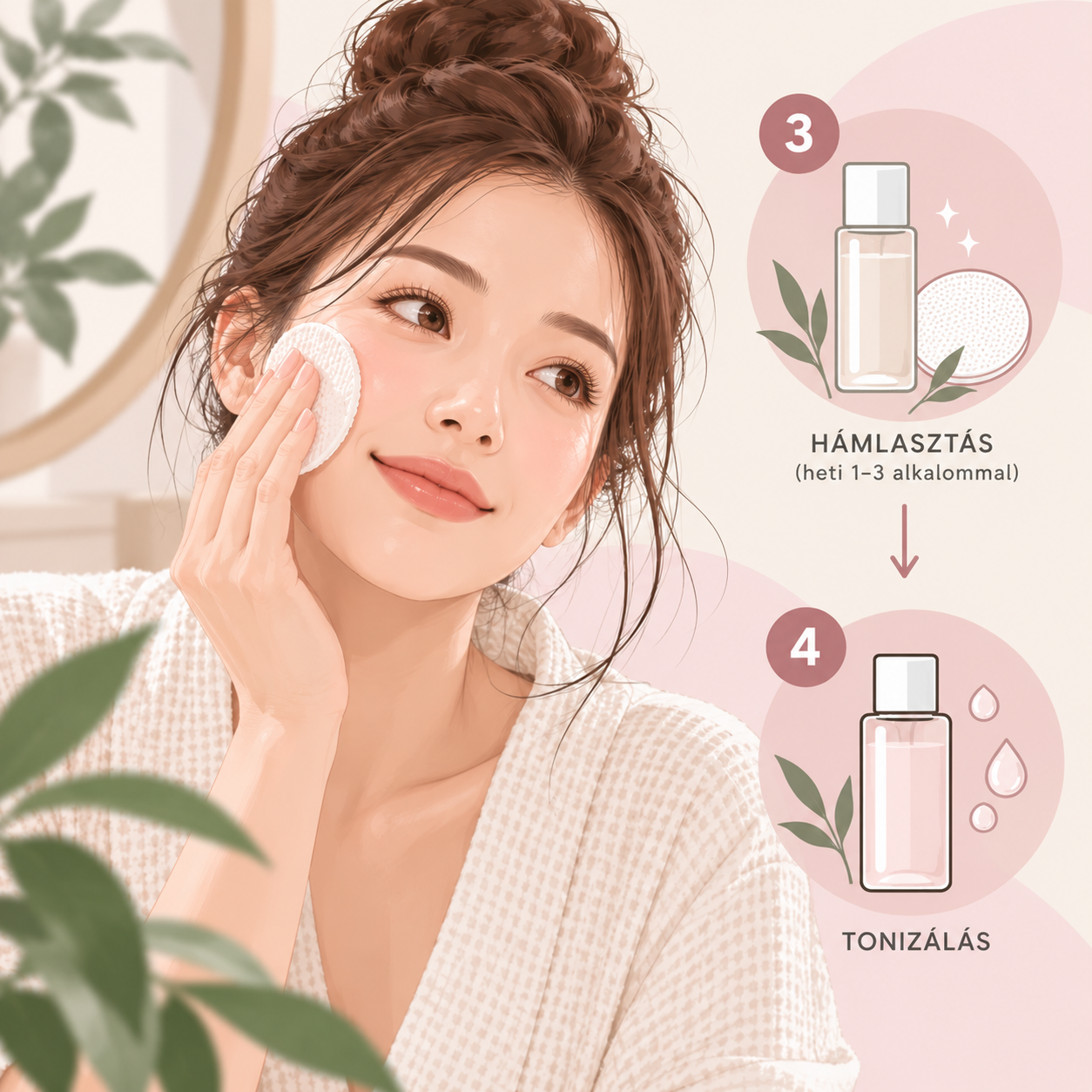
3. Exfoliation
The purpose of exfoliation is to support the removal of dead skin cells on the surface of the skin. When chosen and used appropriately, it can contribute to a more even, smoother skin surface, but this is the step where it is especially unwise to follow the “more is better” principle.
In Korean cosmetics, you will often encounter, for example, AHA, BHA, and PHA acids, as well as enzymatic exfoliating formulas.
The 1–3 times per week shown in our image sequence is therefore a guideline, not a requirement. The appropriate frequency depends on the specific product, its strength, the other active ingredients used, and above all, your skin’s tolerance.
If you are just starting to use an exfoliant, it is advisable to begin less frequently and monitor your skin’s reaction.
A burning sensation, persistent redness, severe tightness or peeling are not results you should endure as proof of effectiveness.
4. Toning
The modern Korean toner is often a completely different product type compared to the old, strongly astringent tonics.
Many K-beauty toners primarily serve as a light moisturising or skin-soothing layer, and depending on the formula, may also contain various targeted ingredients.
You can use your palm, gently patting it into the skin; usually, a cotton pad is not necessary unless the product itself or its method of use requires it.
And no: the toner is not mandatory either. If your routine works well without it, you don’t need to include it just to reach ten steps.
💧 5–6. Essence, serum and ampoule – when we personalise the routine
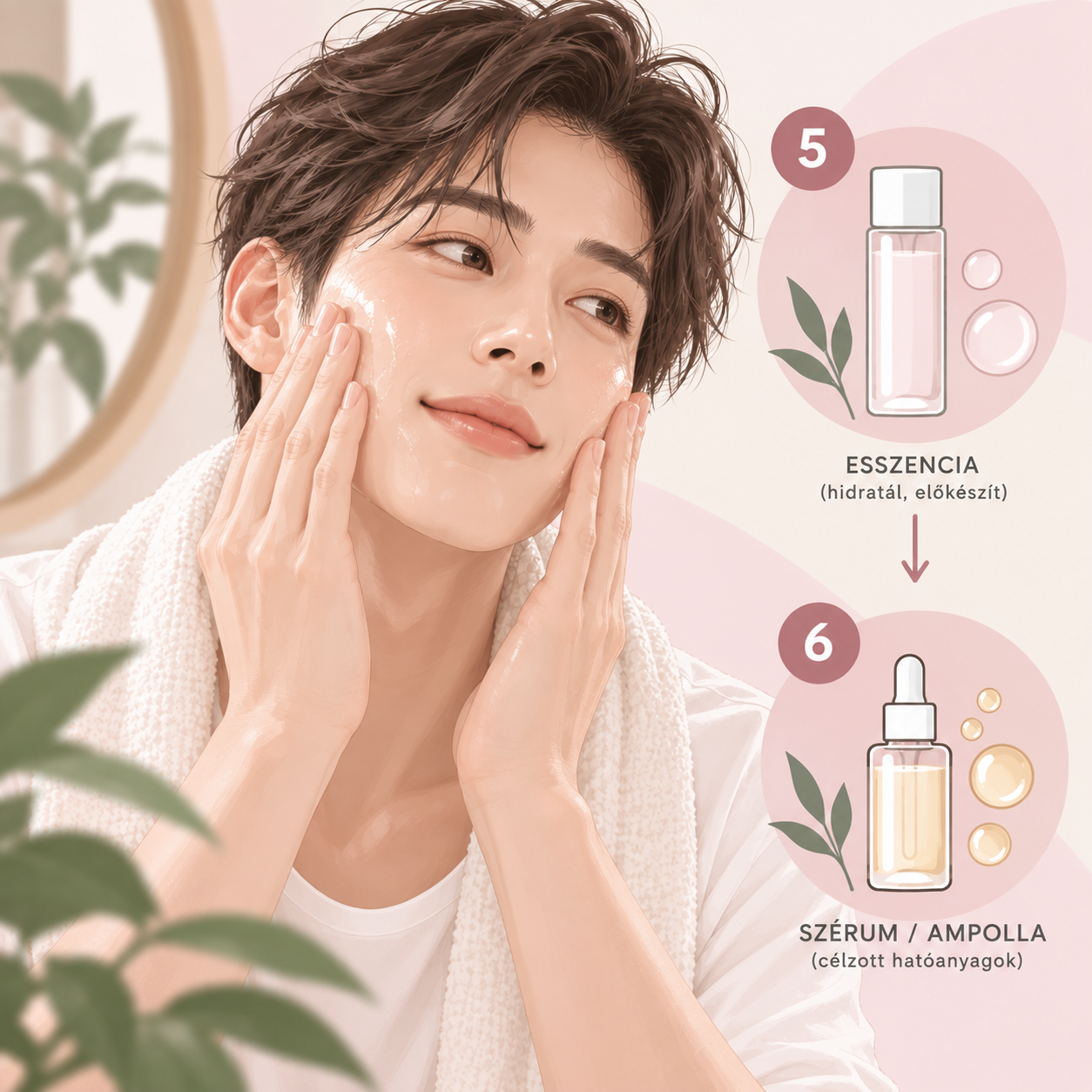
5. Essence
The essence is a distinctive product type in Korean skincare. It is generally lightweight in texture and traditionally applied after the toner and before the richer serums.
It can primarily be hydrating, but may also contain fermented ingredients, antioxidants, soothing agents, or other targeted active substances.
Here it becomes clear why it is not advisable to rigidly adhere to the ten steps: the functions of a toner and an essence can partially overlap.
If you have a richer, hydrating toner, you might not need a separate essence. However, if you enjoy light layering, there can be a place for both in your routine.
6. Serum or ampoule
This is one of the most customizable points of the routine.
Here, it is no longer worth asking “which serum is the best?”, but rather: “What do I want to achieve with it?”
- hydration and reduction of water deficiency;
- alleviation of redness and unpleasant skin sensations;
- improvement in the appearance of pigmentation spots and uneven skin tone;
- targeted care for acne-prone skin;
- fine lines and loss of firmness;
- supporting the skin barrier.
The goal is not to apply as many serums on top of each other as possible.
A well-chosen serum often makes for a more sensible routine than using four just because we have read good things about each individually.
If you are looking for a targeted active ingredient, read our detailed guides on azelaic acid, kojic acid, and retinol and retinal.
🎭 7–8. Veil mask and eye contour care – the optional luxury
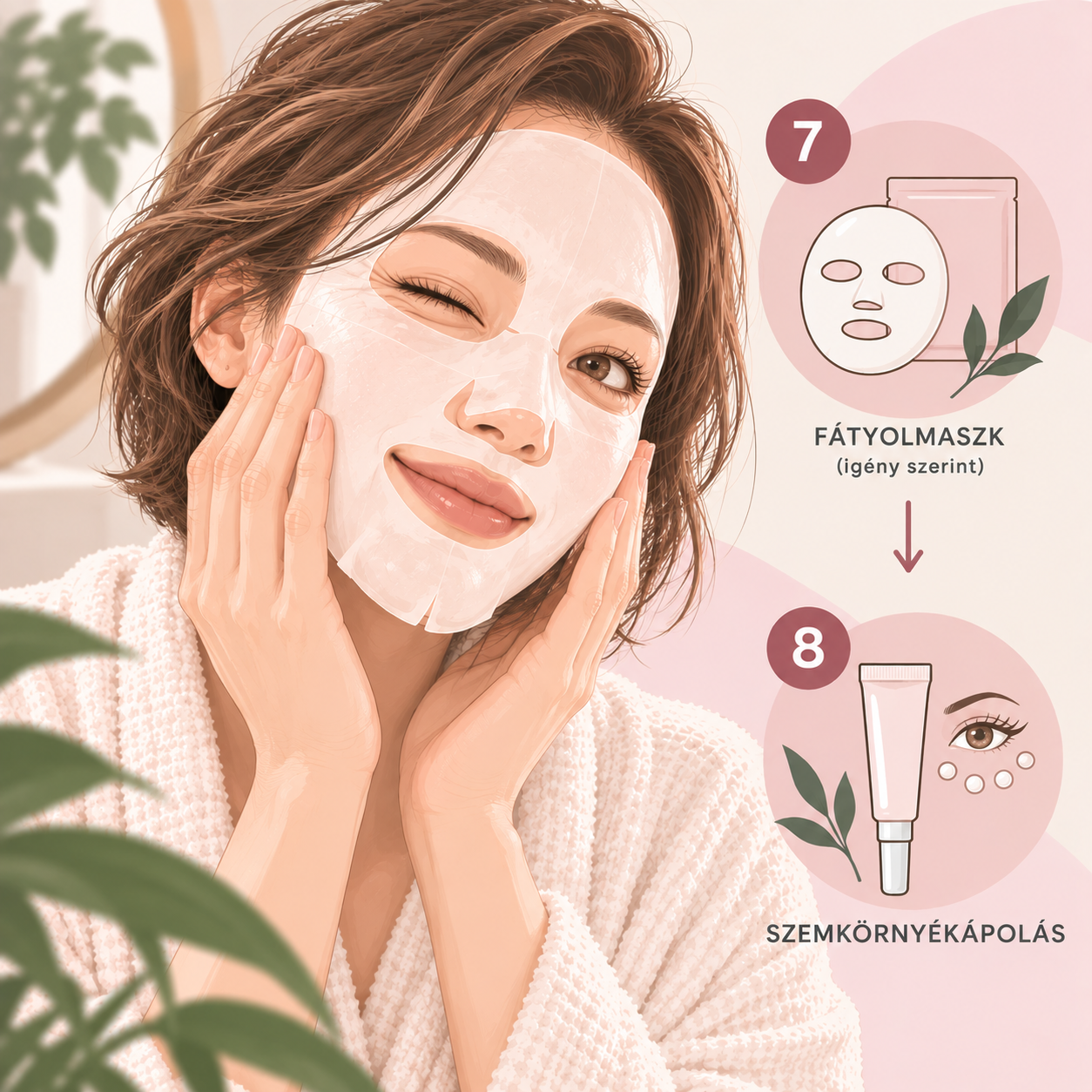
7. Veil Mask
The veil mask is perhaps one of the most well-known K-beauty products – and at the same time a perfect example that the classic ten-step does not mean ten days of obligation.
You can use it when you desire extra hydration or soothing care, or simply enjoy spending a few minutes on your skincare ritual.
However, the face mask is a supplementary product, not a replacement for your basic routine. It is also important to note that if the mask contains the same potent active ingredients as other products you are already using, excessive layering may increase the risk of dryness and irritation. Therefore, it is not recommended to use exfoliating masks too frequently.
8. Eye Contour Care
The skin around the eyes is a unique area, which is why many people prefer to use products specifically developed for it.
But let this be your next liberating sentence: you can have a complete routine even without eye contour care products.
If you use it, you can choose a simple moisturizer or a more targeted formula. However, with stronger active ingredients – such as retinoids – it is especially important to follow the usage instructions of the specific product.
 Which comes first, the face mask or the moisturizer?
 Which comes first, the face mask or the moisturizer?
This question deserves a separate explanation, as the order causes uncertainty for many.
The sheet mask goes on first, followed by the moisturiser.
Apply the sheet mask after cleansing and after the lighter layers used beforehand. Keep it on for as long as the manufacturer recommends; longer is not necessarily better, as excessive or too frequent use can cause irritation. After removal, the essence left on the skin can usually be gently patted in, then the moisturiser can be applied.
However, the specific mask’s instructions for use always take precedence over the general rules.
☀️ 9–10. Hydration and sun protection – returning to the basics
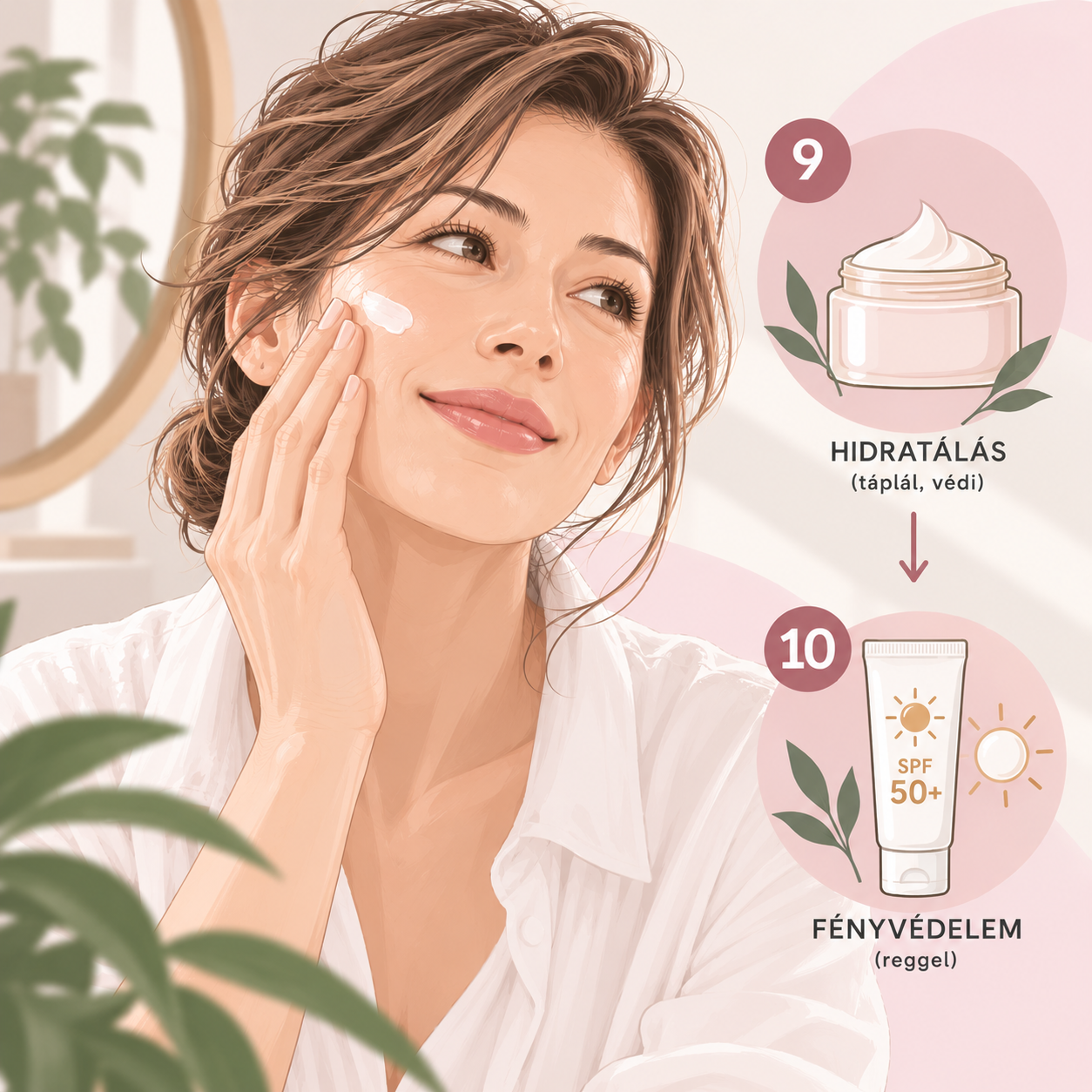
9. Hydration
A moisturizer does not simply “seal in serums”.
Moisturising formulations can support the maintenance of the skin’s proper water content and barrier function in various ways. Humectants aid in water retention, emollients smooth and soften the stratum corneum, and occlusive ingredients reduce water loss.
Therefore, even oily skin may require hydration – just not necessarily the same texture as dry skin.
Light gel, emulsion, or richer cream? The choice is influenced not only by skin type but also by the current skin condition, the season, the environment, and the rest of the routine.
10. Sun Protection
Of the classic ten steps, this only appears in the morning – but then as the final step of the skincare routine.
The long-term importance of regular sun protection is supported not only by cosmetic theories.
In a randomised study involving 903 adults, the group assigned to daily use of broad-spectrum sunscreen showed 24% less skin ageing after 4.5 years compared to baseline, than the group using sunscreen at their own discretion.
If there is no time left for sun protection in a long morning routine, it is better to skip some of the previous steps instead. Sunscreen is not the 10th step because it is the least important – it simply belongs at the end of the routine.
The reason for this is that the role of sunscreen is to create an even, continuous protective layer on the surface of the skin. If other cosmetics are applied afterwards, rubbing and layering can disturb this layer, resulting in uneven coverage. That is why sunscreen is applied as the last step in the morning skincare routine – and only then does makeup follow, if used.
🍝 So, do you really need all 10 steps?
No.
And if you are just starting Korean skincare, it is especially unwise to introduce ten new cosmetics overnight.
If you start using many new products at once, it will be difficult to determine which one benefits you and which causes problems; therefore, a gradual introduction of products is recommended.
💡 MyBelle tip – you don’t have to eat through the entire menu
Think again about that Italian dinner.
Just because the full menu may include antipasto, primo piatto, secondo piatto, contorno and dolce, it doesn’t mean the dinner is good because you eat everything.
Sometimes, a good dough is just enough.
Alright then. Maybe a little dessert can still fit in. 😉
The best skincare routine is the one tailored to your skin’s needs – not the one with the most steps.
Moreover, if you introduce eight new cosmetics at once and a few days later irritation, itching or redness occurs, it will be very difficult to determine which product caused it.
Therefore, with a new cosmetic, not only gradual introduction can be useful, but it is also recommended to test the new product on a small area of skin first.
🌱 If you're just starting out: build the foundations
If you are just getting acquainted with Korean skincare, it is not advisable to start with ten different products right away.
Begin with a few well-chosen basic steps, and only supplement your routine if your skin truly needs it.
It may be that three steps will be enough. It may be that over time you find a place for five or six products in it. And it may also be that you will never need all ten.
It is not the number of steps that matters, but that each has a reason and role in your routine.
Simple morning routine
Gentle cleansing → moisturiser → sunscreen
Simple evening routine
Cleansing → moisturising
If you are wearing makeup or sunscreen that is harder to remove:
Oil-based cleanser → water-based cleanser → moisturiser
And done.
This can already be a completely sensible skincare routine.
And if you want to address a specific issue, the next step is not necessarily five new products. It can simply be a single well-chosen targeted serum.
If you want to get started as simply as possible, also read our guide on the 3-step Korean skincare routine.
🪜 If you want more: a 5-step Korean routine
An extended, yet still simple routine might look like this:
Morning:
cleansing → toner or essence → targeted serum → moisturizer → sunscreen
Evening:
cleansing → toner or essence → targeted serum → moisturizer
If necessary, the evening cleansing may consist of two steps.
And for many people, this is where the story ends.
There is no need to extend it further just because there is a sixth, seventh, and eighth step.
However, if you enjoy the skincare ritual itself, your skin tolerates layering well, and each product has a clear purpose, you can certainly have a more complex routine.
🧴 How to layer Korean cosmetics?
A good general guideline is to progress from lighter, more watery textures to richer formulas.
Typically:
toner → essence → serum/ampoule → eye cream → moisturizer → sunscreen in the morning
But this is not set in stone.
The texture and composition of individual products may vary, so if the manufacturer recommends a different order or method of use, it is advisable to follow that. Sunscreen is the final step in the morning skincare routine – after that, only makeup follows, if you use it.
And it is not necessary to wait ten minutes between each layer of light moisturizer. For most cosmetics, it is sufficient that the previous layer has been absorbed or spread on the skin enough for the next to be applied comfortably.
🌞🌙 Morning or evening routine – what is the difference?
The two routines are not necessarily the same.
In the morning, hydration, care chosen according to the specific skin needs, and finally sun protection come to the fore.
In the evening, thorough cleansing takes a more prominent role, and many people use targeted active ingredients at this time, which, according to the specific formula or usage instructions, are advisable to apply in the evening.
Exfoliation and sheet masks are not included in the top ten list just to be ticked off every evening.
Moreover, our skin changes. Its needs may differ in winter and summer, in dry air and high humidity, or during a more sensitive period.
The routine adapts to the skin – not the skin to the routine.
⚠️ The most common mistakes in the 10-step routine
“If ten steps are good, twelve are even better.”
Not necessarily. Too many products can increase the risk of irritation without providing proportionally more benefits.
Too many active ingredients at once.
Cramping retinoids, exfoliants, and several other targeted ingredients into a single routine does not automatically make skincare more professional.
We start using all new products at the same time.
This makes it difficult not only to identify the cause of any irritation but also to determine which product actually brought about an improvement.
The trend becomes more important than your own skin.
Just because a product appears in every other video does not necessarily mean that it is what your routine is missing.
There is “no room left” for sunscreen.
If, due to the previous nine steps, you run out of time or patience by the end of your morning routine, simplify.
📋 The 10-step Korean routine at a glance
| Step | Role | When? | Necessary? |
|---|---|---|---|
| 1. Oil-based cleanser | removal of makeup, sebum, and more stubborn sunscreens | in the evening | as needed |
| 2. Water-based cleanser | gentle cleansing | morning/evening, as required | basic step |
| 3. Exfoliant | supporting the removal of dead skin cells | occasionally | optional |
| 4. Toner | moisturising/soothing or targeted layer | morning/evening | optional |
| 5. Essence | light moisturiser or targeted treatment | morning/evening | optional |
| 6. Serum/ampoule | targeted skincare | depends on the formula | on request |
| 7. Veil Mask | extra care, hydration | occasionally | optional |
| 8. Eye Contour Care | targeted care of the eye contour | morning/evening | optional |
| 9. Moisturiser | hydration and barrier support | morning/evening | basic step |
| 10. Sunscreen | UV protection | morning | basic step |
❓ Frequently Asked Questions about the Korean Skincare Routine
Do all Korean women use a 10-step routine?
No. The “10-step Korean routine” is a widely known K-beauty framework, not a general or mandatory skincare routine followed by Korean women. In reality, Korean skincare is also personalised: some use a few basic steps, others follow a more complex routine, and this can vary depending on the current skin condition, individual needs, and the products used.
The essence of Korean skincare is therefore not the number of steps, but a consciously structured routine tailored to the needs of the skin.
Is it necessary to use an oil cleanser in the morning?
Generally, it is not necessary. Oil cleansing is primarily useful in the evening routine for removing makeup and more stubborn sunscreens.
Do I need both toner and essence?
No. Their functions may partly overlap, so you can safely choose just one – or neither, if you don’t need them.
Can I layer multiple serums?
You can, but it’s advisable to first determine what goal you want to achieve. Just because two serums are good individually doesn’t mean you need both together.
Should I use the sheet mask before or after the moisturizer?
Before the moisturizer. Usually, the moisturizer follows after the sheet mask. However, always check the specific mask’s instructions for use.
How long should I wait between two layers?
For most cosmetics, it is not necessary to time the interval between layers with a stopwatch. Generally, it is sufficient to wait until the previous product has absorbed or spread on the skin enough for the next one to be applied comfortably. If the product’s instructions for use recommend a different application or waiting time, it is always best to follow those guidelines.
How long does it take to see the results of a new routine?
This depends on what you want to achieve, which products you use, and the condition of your skin. Changes in hydration and comfort can be noticed relatively quickly, whereas improvements in pigmentation spots, acne, or visible signs of skin ageing generally require longer, consistent use.
In skincare, it is therefore advisable to allow time for a well-assembled routine, rather than replacing it with new and new products after just a few days.
💜 So, which is the best Korean skincare routine?
The one that works for your skin.
One of the most valuable lessons of Korean skincare is not that we need ten different cosmetics.
But that it is worth paying attention to our skin.
Gently cleanse. Properly hydrate. Protect from UV radiation. And if there is a specific skin issue or goal, consciously select the active ingredient and product that truly belong in the routine.
For you, this might be three steps.
It can be five.
And there can be evenings when the essence, the ampoule, the sheet mask and the whole longer ritual feel good.
Each can be a good routine.
The ten steps show what can be put on the table.
But you don’t have to eat through the entire menu every evening. 🍝
Just know what you are choosing from it – and why.
📚 References
Chen W, He M, Xie L, Li L. The optimal cleansing method for the removal of sunscreen: Water, cleanser or cleansing oil? Journal of Cosmetic Dermatology. 2020;19(1):180–184. – Clinical study on the efficacy of different cleansing methods for sunscreen removal. PubMed
Hughes MCB, Williams GM, Baker P, Green AC. Sunscreen and prevention of skin aging: a randomised trial. Annals of Internal Medicine. 2013;158(11):781–790. – Randomised trial on the relationship between regular sunscreen use and photoageing. PubMed
Sethi A, Kaur T, Malhotra SK, Gambhir ML. The Skin Barrier and Moisturisation: Function, Disruption, and Mechanisms of Repair. Journal of Clinical Medicine. 2023. – An overview of skin barrier function and the role of moisturising formulations. PubMed
American Academy of Dermatology Association. Should I apply my skin care products in a certain order? – About the order of skin care products and the possibility of irritation caused by using too many products. AAD
American Academy of Dermatology Association. Do facial masks work, and should I add one to my skin care routine? – On the proper use of facial masks, the risks of overuse and the accumulation of active ingredients. AAD
Cleveland Clinic. Steps to a Korean Skin Care Routine. – An introduction to the classic ten-step K-beauty system and considerations for gradually building your routine. Cleveland Clinic
